
Where others see danger, we see opportunity
The AI conversation in the assistant world has been dominated by fear. But the research tells a more interesting story, and what we’re seeing inside our own community confirms it. The opportunity for assistants in AI is bigger than most people are saying, and the gap between what AI can theoretically do and what’s actually happening inside most organizations right now is where that opportunity lives.
In this piece we break down what the research actually shows, what we heard when we asked a room full of assistants what they’re really doing with AI, and why automation, augmentation, and amplification aren’t just buzzwords, they’re the thing.
The fearmongering phase of AI is quieting down
For a while, every headline was a warning. ‘’Something big is happening’’. Your job is at risk. Admin roles are disappearing. AI is coming for the to-do list. Lots of speculation, little facts. And then the research started catching up with the noise, and it told a more interesting story than the headlines suggested.
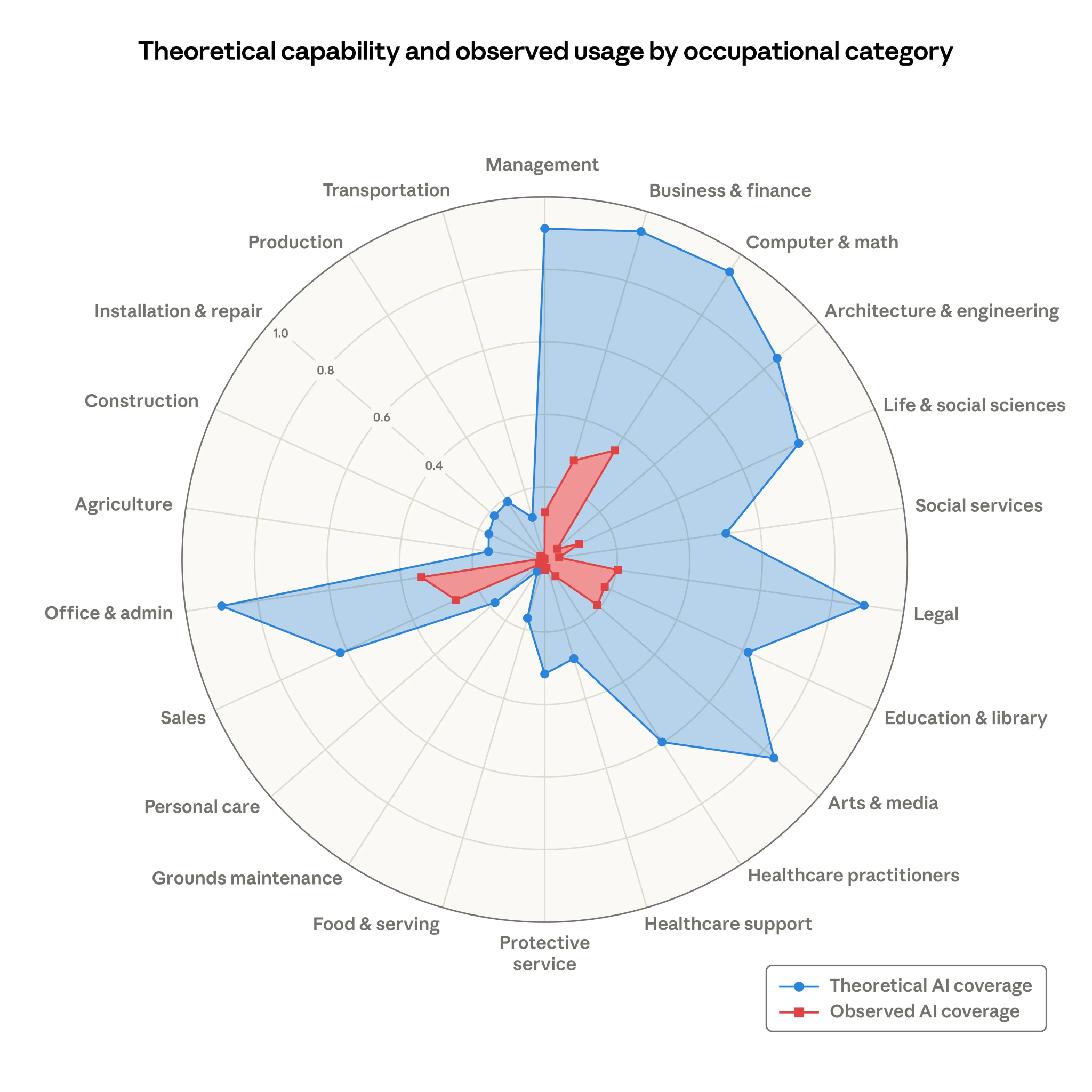
Anthropic, makers of Claude, published a report entitled, Labor Market Impacts of AI: A New Measure and Early Evidence that looked at not just what AI is theoretically capable of, but what it is actually being used for inside real workplaces right now. And the gap between those two things is enormous.
The report says that in office and admin roles, AI is actually being used for around 25% of tasks right now. It also reports that 90% of tasks in those roles could potentially be handled by AI one day. But “could” and “is” are very different things. And right now, the gap between them is huge.
We see that gap as a window, not as a warning. It removes the tedious work and frees up your capacity for higher value contributions. We believe those who leverage AI now, while most organizations are still figuring it out, are not only going to stand out as innovative leaders, but will also shape what the future of the role looks like.
The reframe that’s missing from the assistant conversation
Two things can be true at the same time. The jobs most at risk from AI are also the jobs that have the most to gain from it. For assistants, that means this role isn’t just exposed to the risk of AI, it’s one of the roles where using AI will make the biggest difference.
AI could assist with a significant chunk of what assistants do. The repetitive tasks, the formatting, the scheduling, the first-draft everything. But those are also exactly the tasks that AI can help an assistant offload, automate, and stop spending time on, freeing them up for the higher-value work that actually requires a human. That’s the opportunity.
Maybe, and this is the part we find genuinely exciting, using AI well in this role will finally do what job titles and org charts never quite managed. Proving the true value of what assistants actually do. Because when the repetitive work runs itself, what’s left is undeniably human. Undeniably skilled. And a lot harder to overlook.
An assistant who ignores AI and keeps doing everything manually is more exposed to being replaced or overlooked. An assistant who uses AI to automate low-value work and concentrate their energy on the judgment, building relationships, and strategic thinking becomes more valuable, not less.
Let’s look at travel booking. On the surface, the task is “book flights and a hotel.” But the actual task is making sure your executive lands rested, prepared, and not stressed before the most important meeting of their quarter. AI can book the flights. But you know to tuck an extra charger in their bag before they leave the office because they never remember, that marketing needs to give them their final analysis before takeoff so they can review it on the plane, and to block the team from calling them until after the important meeting or they will get distracted and risk being focused.our executive won’t ask you for any of this because they trust you to already know.
AI executes the task. The assistant understands why it matters. The task is the surface. Underneath it is judgment, observation, nuance, knowledge, and care. The outcome isn’t determined by AI, it’s determined by the administrative professional.
Same tools. Very different outcomes.
Let’s look at the difference in how most administrative professionals are using AI.Most assistants are using AI for augmentation. Augmentation is using AI to do what you already to but better and faster such as drafting emails, writing exec summaries, pulling together board reports, and generating policies. All genuinely useful, but every single one of those tasks still runs through the assistants. They prompt it, they review it, they send it. Nothing happens without them in the loop. The to-do list didn’t shrink. It just moved a bit faster.
Then there’s what one assistant shared in that session.
She used AI to teach her how to build a system using Power Automate that circulates legal update emails across her entire organizationorganization, tracks who has responded, and sends follow-up chasers automatically every two days until they do. She doesn’t touch it. It runs.
Think about what that actually means in practice. Legal updates in her organizationorganization no longer depend on someone remembering to chase. In a compliance context, that’s significant. Response rates are higher and more consistent. The audit trail is built in. The legal team has full visibility of who’s acknowledged what, without anyone manually compiling it. And the mental load of tracking all of that, which used to sit on her plate, now runs itself.
That’s not augmentation, that’s automation. And the difference matters.
We showcased the importance of leveling up how administrative professionals use AI, in a recent automation session. Lauren asked one question, “Is anyone actually using AI to automate a whole process?” Only a handful of attendees had begun automating parts of the role, but the vast majority had not yet considered it.
And that gap is where the opportunity lives.
As Lauren said in the session, “This is what actually removes work from you.” Building something that does the task for you while you get on with the things only a human can do.
So let’s talk about what’s actually going on
Workloads are not shrinking. The irony is that being told to adopt AI has itself become another thing on the to-do list. Learning new tools, figuring out what works, building prompts, testing outputs. None of that is effortless, and it lands on top of an already full workload. So instead of AI immediately lightening the load, for a lot of people it’s initially added to it.
Using AI to draft a document is useful, but it still requires you. Automation is different. Automation is building something that does the task without you at all. Emails that file themselves. Chasers that go out on schedule. Workflows that run while you’re doing something else entirely. That’s what actually takes work off your plate.
And right now, most assistants aren’t there yet. But the ones who are? They’re not more talented. They’re not more technical. They just moved toward it earlier. There is time to catch up.
Technology is your assistant. The question is whether you’re making it work for you, or whether you’re still doing everything yourself with a slightly faster drafting tool.
Three dimensions, not one
That travel booking example is a good illustration of something we’ve been saying and teaching inside The Officials for a long time. The real opportunity in AI for assistants isn’t one thing. It’s three.
Automation means removing the work that shouldn’t require you at all. You build it once. It runs without you. You’re not in the loop because you don’t need to be. As Lauren said in our session, “This is what actually removes work from you.” Not AI chat. Not generating an email. Building something that does the task for you while you get on with the things only a human can do. That’s not laziness. That’s leverage. And yes, building automations can be frustrating at first. It’s something we hear a lot inside The Officials community, and it’s something we work through together. The breakthroughs tend to come faster when you’re not figuring it out alone.
Augmentation, like we said above, means doing what you already do, but better and faster. Writing the exec summary you’d have spent an hour on in ten minutes. Drafting the board report, the policy document, the business case, and then applying your knowledge and judgment to make it actually right. AI gets you to a strong first draft. You bring everything that makes it yours.
Amplification is the biggest shift of all. Using AI not just to do or enhance tasks, but to change how you think about your role entirely. AI as a strategic thinking partner. The assistant who doesn’t just execute brilliantly but anticipates, shapes decisions, and leads from their position. This is where the role is heading, and the assistants who get there first will define what it looks like.
The competitive advantage assistants hold isn’t the ability to complete tasks faster. It’s everything AI cannot replicate, and in this role specifically, that list is longer and more significant than in almost any other profession. For example:
Discretion. The judgment to know what to say, what not to say, and to whom. Earned through time, trust, and deep knowledge of the people and organisation you work within. No AI has access to any of that.
Relational intelligence. Knowing your executive’s mood, their blind spots, their communication style, what they need before they’ve asked. That kind of trust isn’t built through prompts. It’s built through years of showing up.
Institutional knowledge. An assistant holds a version of the organisation in their head that exists nowhere else. Who actually makes decisions. How things really get done. Where the landmines are. AI trained on data will never have that, because most of it was never written down.
AI needs human input to function. Assistants read human output. That’s the difference. We operate in human code, the unspoken, the unfinished, the between the lines. We know how to extract what’s needed before it’s been articulated, and how to read what’s really going on when nobody’s saying it out loud. That is not a task. That is one of the most sophisticated skills a professional can bring to the table. And it’s one AI simply doesn’t have.
So here’s what we’re building
Our upcoming AI content is our direct response to the gap.
Not a tool review. Not a one-off session. A proper, ongoing curriculum built around automation, augmentation, and amplification, designed to meet you wherever you are right now and take you somewhere genuinely useful.
Haven’t started and don’t know where to begin? Been experimenting for months and getting mixed results? Already doing impressive things and want to go further? All of you belong here.
Monthly sessions covering the skills that actually move the needle. Real use cases and practical resources built for the assistant role specifically, not generic AI content repurposed from the tech world. Ethics and safety content for the full picture. And conversations with assistants who’ve gone deep, so you’re learning from people in roles just like yours.
We’re starting with the foundations because that’s where the biggest, fastest gains are. Most people are one or two insights away from AI actually working properly for them. Once you see what you’ve been missing, you can’t unsee it.
Our new monthly AI series kicks off April 2026! You need to be there.
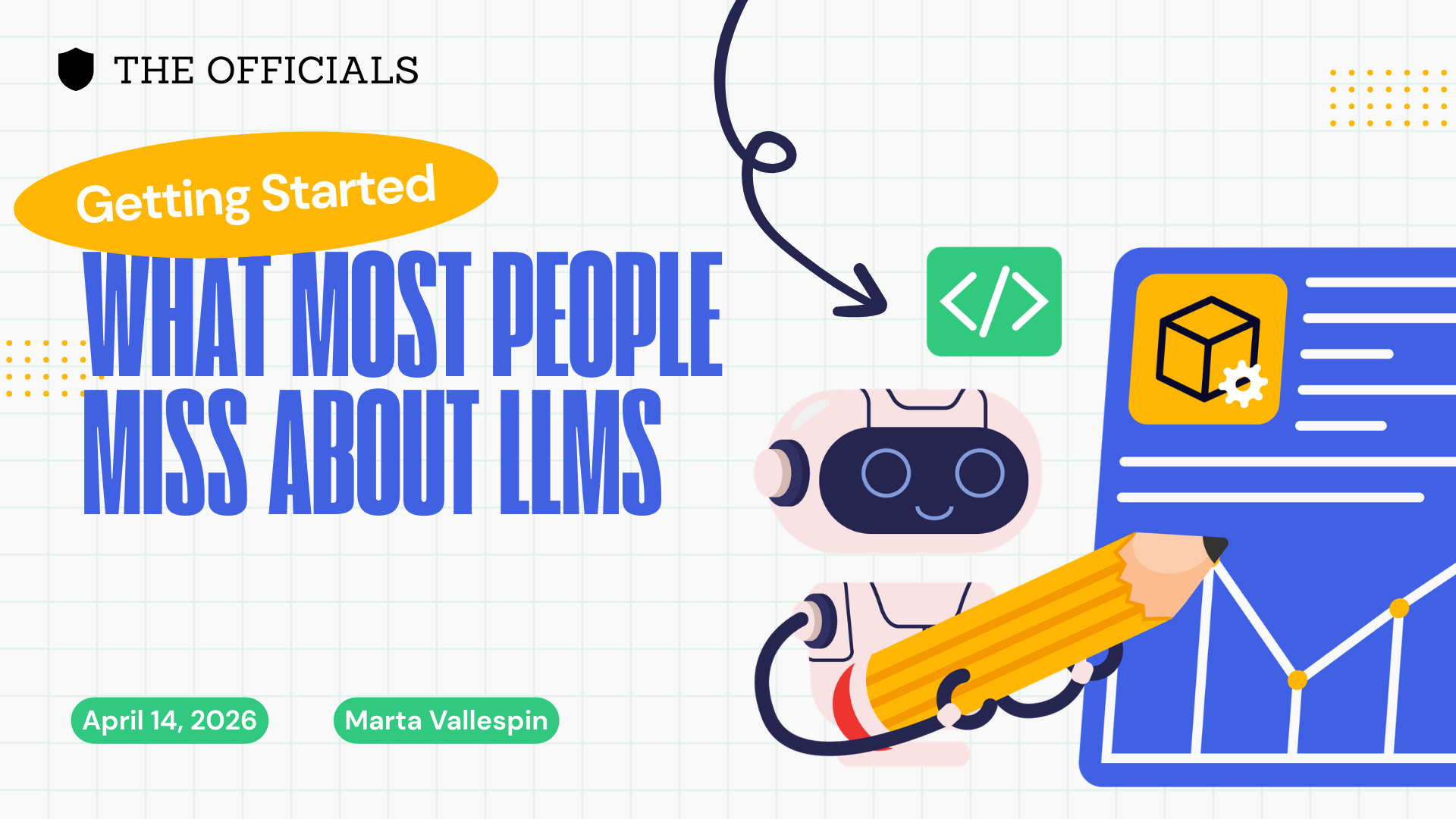
Getting Started – What Most People Miss About LLMs
Tue Apr 14 2026
8-9am PT | 11am-12pm ET | 4-5pm UK
Most people are somewhere in the middle right now. Using AI occasionally, getting patchy results, not quite sure what they’re missing. This session fixes that foundation. What an LLM actually is and how it thinks. What a prompt really does and why most people are getting it wrong. How to set up ChatGPT and Claude so they work for you from day one, not just occasionally.
The gap between average results and genuinely useful AI closes fast once you know what you’re actually doing. This is where that starts.
Seats are limited. Don’t be the person who meant to sign up.